Thinking about straightening your teeth but not sure where to start with the cost? You are not alone. Affordable clear aligners are one of the most searched topics in Australian dentistry right now, and the pricing landscape can be genuinely confusing.
At Riverlands Dental in North Richmond, our team takes the time to explain your teeth straightening options clearly, so you can make a well-informed decision without any surprises.
Quick Overview
- What it is: Clear aligner treatment is a removable, transparent orthodontic option used to gradually shift teeth into better alignment
- Who it may apply to: Adults and older teenagers with mild to moderate crowding, spacing, or alignment concerns may be suitable candidates; complex bite issues often require additional assessment
- What it involves: A series of custom-made trays worn over the upper and lower arches, changed at regular intervals according to your treatment plan
- What influences outcomes: Case complexity, how consistently aligners are worn, and individual treatment duration all affect what to expect from clear aligner therapy
- What guides next steps: A clinical consultation and assessment allow your dentist to determine whether clear aligners are appropriate and give you accurate cost and timeline information
Keep reading to understand how affordable clear aligners work, what drives the cost in Australia, and what questions are worth asking before you commit.
What are clear aligners and how do they work?
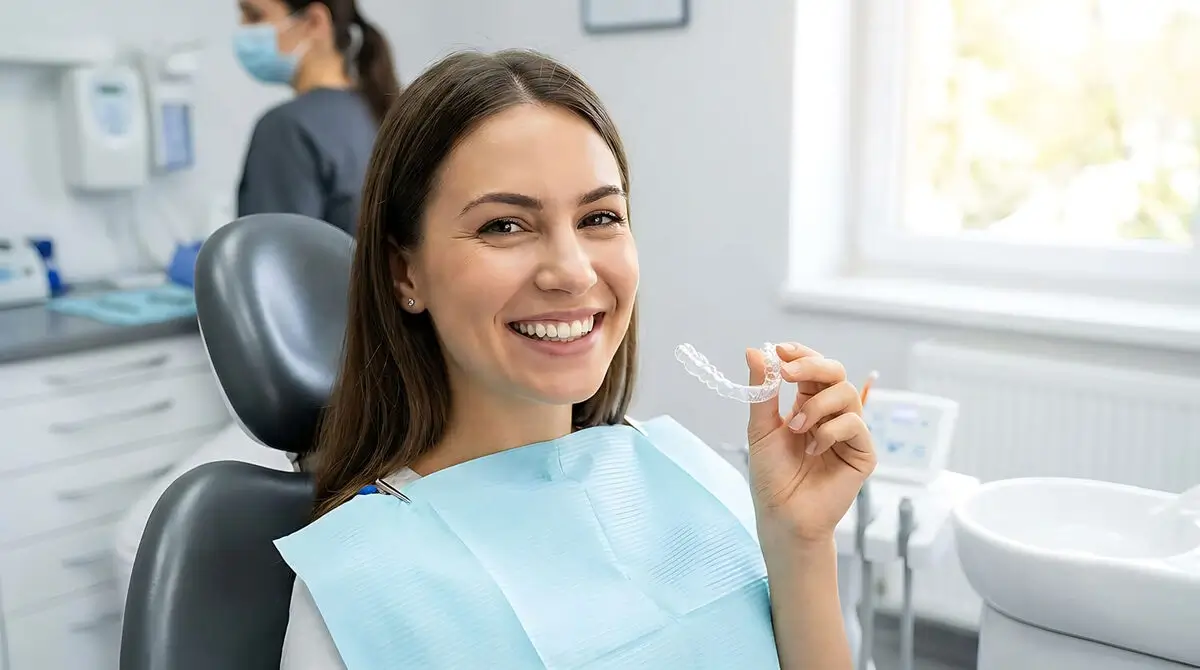
 Clear aligners are custom-made, removable trays worn over both the upper and lower arches of your teeth. Each tray is shaped slightly differently from the last, applying gentle, controlled pressure to gradually shift teeth toward their target position. You wear each set for a prescribed period, typically one to two weeks, before moving to the next.
The trays are made from transparent thermoplastic material, making them far less visible than traditional brackets and wires. They can be removed for eating and for your usual oral hygiene routine, which is one of the practical differences that many people find appealing compared to traditional braces.
The total number of trays, and therefore the length of clear aligner treatment, depends on how much movement is needed. A mild spacing case and a more involved alignment correction will follow very different treatment plans. Your dentist will map this out for you after an initial assessment.
Are clear aligners suitable for everyone?
Clear aligners are well-suited to mild to moderate cases, but not every situation is a good fit. Systematic reviews on aligner effectiveness confirm that clear aligner treatment is effective for mild to moderate malocclusions, but is associated with less predictable outcomes in more severe cases or for certain specific tooth movements.
That means clear aligners work well for many of the most common concerns patients bring to a dentist, including crowded teeth, minor spacing, and some bite irregularities. More complex cases involving significant bite correction or skeletal issues may be better managed with fixed appliances or a combination of approaches.
The only reliable way to find out whether clear aligners are suitable for your situation is a clinical assessment. What looks straightforward to a patient is not always straightforward to treat, and what looks complicated can sometimes be simpler than expected.
How much do affordable clear aligners cost in Australia?
Clear aligner costs in Australia vary considerably, with treatment typically starting from around $3,000 depending on the provider, the treatment system used, case complexity, and treatment duration. Healthdirect Australia notes that costs for orthodontic treatment vary based on clinical need and individual circumstances, and this holds true for aligner therapy specifically.
Several factors shape the final cost:
Case complexity: A mild cosmetic correction with fewer trays costs less than a comprehensive alignment correction requiring more aligners and a longer treatment time.
Treatment duration: Longer treatments require more trays, more clinical reviews, and more chairside time, all of which contribute to the overall fee.
What is included: Some quoted fees cover only the aligners themselves. Others include digital scans, attachments, refinements if needed, and retainers at the end of treatment. Comparing quotes without knowing what each one includes can be misleading.
The provider: In-clinic treatment supervised by a dentist differs from at-home aligner kits purchased online. Direct-to-consumer kits are priced lower, but they are not assessed or supervised in person. This matters particularly for cases that are anything other than very mild.
When you receive a quote at Riverlands Dental, we walk through exactly what is covered. There is no value in a lower headline number if it does not include what you need to complete treatment safely.
Does private health insurance cover clear aligners?
Private health insurance with orthodontic extras cover may contribute toward the cost of clear aligner treatment. Most Australian health funds treat clear aligners in the same category as traditional braces when it comes to benefits. Orthodontic fees are covered by some private health funds, with the amount depending on your specific policy.
 There are several things worth checking with your fund before you begin:
- Whether your extras policy includes orthodontics at all
- Any waiting periods that apply before orthodontic benefits can be claimed
- Your remaining lifetime limit for orthodontics, which is separate from annual dental limits
- Whether the item numbers your dentist provides are covered under your specific plan
Medicare does not cover clear aligners in standard dental settings. Treatment is considered elective, so planning on a Medicare contribution is not realistic for most patients.
If you have held private extras cover for some time and have not used your orthodontic benefit, it is worth checking what is available before you rule out treatment on cost grounds alone.
What affects how long clear aligner treatment takes?
Treatment duration for clear aligners varies. A mild case may take six to twelve months. A more involved correction may take longer. The research on treatment time is mixed: a 2025 systematic review found that clear aligner treatment is appropriate for mild to moderate malocclusions, with case complexity being the primary driver of how long treatment takes.
The other major factor is wear time. Clear aligners are designed to be worn for around 20 to 22 hours per day. If aligners are removed for extended periods regularly, tooth movement slows and the overall treatment time extends. This is a practical reality of removable appliances that is worth understanding before you begin.
At Riverlands Dental, Dr Faris Kirmani has completed advanced training in orthodontics and Invisalign, and will give you a realistic timeline based on your individual assessment, not an aspirational one.
What are the oral hygiene advantages of clear aligners?
One practical advantage of removable aligners over fixed braces is the ability to maintain your usual oral hygiene routine throughout treatment. Because aligners come out for brushing and flossing, there are no brackets or wires to work around.
The research on this is consistent. A 2025 systematic review found that clear aligners were associated with better periodontal health outcomes compared to fixed appliances, with lower plaque levels and reduced gum inflammation observed over the course of treatment. This advantage is attributed primarily to the removable nature of the trays.
This does not mean aligners require no effort. Brushing after meals, before replacing the trays and keeping the trays clean themselves are part of clear aligner care. The point is that the hygiene routine stays manageable throughout treatment, which matters particularly for patients who already deal with sensitivity around the gum line.
A Considered Starting Point at Riverlands Dental
 Clear aligner treatment is not a one-size decision. Suitability, cost, timeline, and what is actually included in a quote all vary significantly between cases. The most useful step you can take is a proper assessment, so you have real numbers and a real treatment plan to consider rather than estimates.
If you have concerns about your alignment or want to understand what is involved for your specific situation, contact Riverlands Dental to arrange a consultation.
Riverlands Dental Richmond can be reached on (02) 4501 7930 or at 4 Grose Vale Rd, North Richmond NSW 2754.
Frequently Asked Questions
Are clear aligners suitable for children?
Clear aligner systems are generally designed for adults and older teenagers whose teeth and jaws have finished developing. For younger children who still have baby teeth or are in the early stages of jaw growth, other orthodontic approaches are typically more appropriate. If you are looking into treatment for a child, the most useful step is a clinical assessment so your dentist can advise on timing and the most suitable option for their stage of development.
Will clear aligners affect my speech?
Some patients notice a slight change in their speech in the first few days of wearing a new set of trays, most commonly a minor lisp. This typically settles within a week or so as the tongue adjusts to the trays. The adjustment period varies between individuals. Speaking regularly while wearing your aligners, including reading aloud, can help the adjustment happen more quickly.
What are attachments, and do they affect how the aligners look?
Attachments are small tooth-coloured shapes bonded to specific teeth before or during clear aligner treatment. They act as anchors, giving the aligner trays something to push against to achieve certain types of tooth movement that would otherwise be difficult. Not every case requires them. When they are used, they are designed to match your tooth colour and are generally not noticeable at conversational distance, though they are more visible up close than the trays alone.
Can I whiten my teeth while undergoing clear aligner treatment?
Teeth whitening during clear aligner treatment is something to discuss with your dentist before starting, as timing matters. Some dentists recommend completing whitening after treatment is finished so that whitening is applied to the final tooth position. Others may advise a different approach depending on your situation. The clear trays themselves do not whiten teeth, but their snug fit means any whitening product applied inside the tray would have prolonged contact with the tooth surface, which requires careful supervision.
References
Yassir, Y.A., Nabbat, S.A., McIntyre, G.T. and Bearn, D.R. (2022). ‘Clinical Effectiveness of Clear Aligner Treatment Compared to Fixed Appliance Treatment: An Overview of Systematic Reviews’. Clinical Oral Investigations, 26(3), March, pp. 2353-2370. Berlin: Springer-Verlag. https://pubmed.ncbi.nlm.nih.gov/34993617/
Healthdirect Australia. (2025). ‘Orthodontic treatments’. Healthdirect Australia. Canberra, ACT: Healthdirect Australia. https://www.healthdirect.gov.au/orthodontic-treatments
Department of Health and Human Services (Victoria). (n.d.). ‘Orthodontist’. Better Health Channel. Melbourne, VIC: Department of Health and Human Services. https://www.betterhealth.vic.gov.au/health/serviceprofiles/orthodontist-service
Hartogsohn, C.R. and Sonnesen, L. (2025). ‘Clear Aligner Treatment: Indications, Advantages, and Adverse Effects: A Systematic Review’. Dentistry Journal, 13(1), 17 January, p. 40. Basel: MDPI. https://pubmed.ncbi.nlm.nih.gov/39851616/
Dipalma, G., Inchingolo, A.D., Fiore, A., Balestriere, L., Nardelli, P., Casamassima, L., Di Venere, D., Palermo, A., Inchingolo, F. and Inchingolo, A.M. (2025). ‘The Differential Impact of Clear Aligners and Fixed Orthodontic Appliances on Periodontal Health: A Systematic Review’. Children, 12(2), 26 January, p. 138. Basel: MDPI. https://www.mdpi.com/2227-9067/12/2/138